Reading time: 8–9 minutes
Electrical harmonics in industrial plants can contribute to overheating, recurring equipment failures and electrical losses that are difficult to explain. The problem often becomes apparent when more variable frequency drives are introduced or automated production lines are expanded: the machinery continues to operate, but transformers, cables and protective devices are subjected to greater stress. Targeted measurements are needed to establish whether harmonic distortion is responsible. Energia Europa supports companies with its Aladin diagnostic system and the PQ-PRO and PQ-MAX compensation devices.
What are electrical harmonics?
In an ideal electrical network, voltage and current follow sinusoidal waveforms at the fundamental frequency. In Italy and much of Europe, that frequency is 50 Hz. Harmonics are components at multiples of the fundamental frequency: the third harmonic is at 150 Hz, the fifth at 250 Hz and the seventh at 350 Hz. When these components are superimposed on the fundamental, the resulting waveform becomes distorted.
Harmonic distortion can affect current, voltage or both. Non-linear loads draw distorted currents; as these currents flow through the system’s impedance, they can also distort the supply voltage. This explains why two factories using similar machinery may experience very different electrical problems.
Power Quality analysis examines these phenomena and their impact on the electrical distribution system. The presence of harmonics does not necessarily indicate a fault. What matters is their magnitude, frequency distribution and the ability of the system’s components to withstand them.
KEY POINT — Harmonics are electrical components at multiples of the fundamental frequency. Their impact depends on the loads and the electrical system, not simply on whether an inverter is present.
Where do harmonics come from in industrial plants?
Consider a production line with motors controlled by variable frequency drives. Electronic speed control allows motor speed and torque to match production requirements, but the drive’s rectifier may draw a non-sinusoidal current. If several converters operate on the same electrical distribution system, their combined harmonic contribution can become significant.
Common sources include variable frequency drives, rectifiers, switch-mode power supplies, UPS systems and some welding equipment. LED drivers and photovoltaic inverters may also contribute to distortion, depending on their design and operating conditions.
Simply counting the devices installed is not enough. Harmonic levels depend on how equipment is used, operating loads and network impedance. Measurements taken during a full production shift may reveal a different picture from those recorded while machinery is starting up.
For energy-intensive businesses, Energia Europa considers these issues as part of Power Quality for companies, assessing electrical disturbances, load characteristics and production continuity together.
Further reading: explore our interview on Power Quality devices for energy-intensive industries, which examines electrical problems that conventional energy consumption monitoring can miss.
Effects of harmonics on electrical systems
Overheating is one warning sign worth investigating. Harmonics contribute to RMS current and may increase losses in cables and transformers. In some three-phase systems with numerous single-phase loads, harmonics that are multiples of the third order can also add together in the neutral conductor, leading to high neutral currents.
The consequences depend on the network’s characteristics. Engineers may encounter unexpected protective-device trips, additional stress on power factor correction capacitors, interference with sensitive equipment and accelerated ageing of certain components. Depending on the configuration of the power factor correction system, harmonic resonance may also need to be assessed.
Imagine a production department where an electronic device keeps failing. Replacing the unit without investigating its power supply may leave the underlying problem unresolved. Likewise, a hot electrical enclosure is not, by itself, proof of harmonic distortion. Measurements are needed to distinguish harmonics from overloads, poor connections or other electrical disturbances.
KEY POINT — Overheating and unexpected protective-device trips can be effects of harmonic distortion, but they are not a diagnosis. Electrical measurements are required to confirm the cause.
If your plant is experiencing recurring electrical problems, call Energia Europa on +39 0445 510 156 or describe the issue using our contact form. An initial assessment can help determine which checks are needed.
Further reading: see How to Reduce Network Losses to understand the relationship between electrical distribution, energy losses and operating costs.
How to measure harmonic distortion
Assessment begins by measuring voltages and currents at relevant points in the electrical system. Two useful indicators are THDi, total harmonic distortion of current, and THDv, total harmonic distortion of voltage. These percentages must be interpreted alongside actual current levels, the harmonic spectrum and the operating conditions under which the readings were taken.
A high THDi value alone does not show how much harmonic current needs to be compensated. Even with the same percentage, sizing requirements can differ considerably between a lightly loaded circuit and one supplying large drives. It is therefore important to examine individual harmonic orders and record how they vary throughout the production cycle.
Aladin: reliable data before taking action
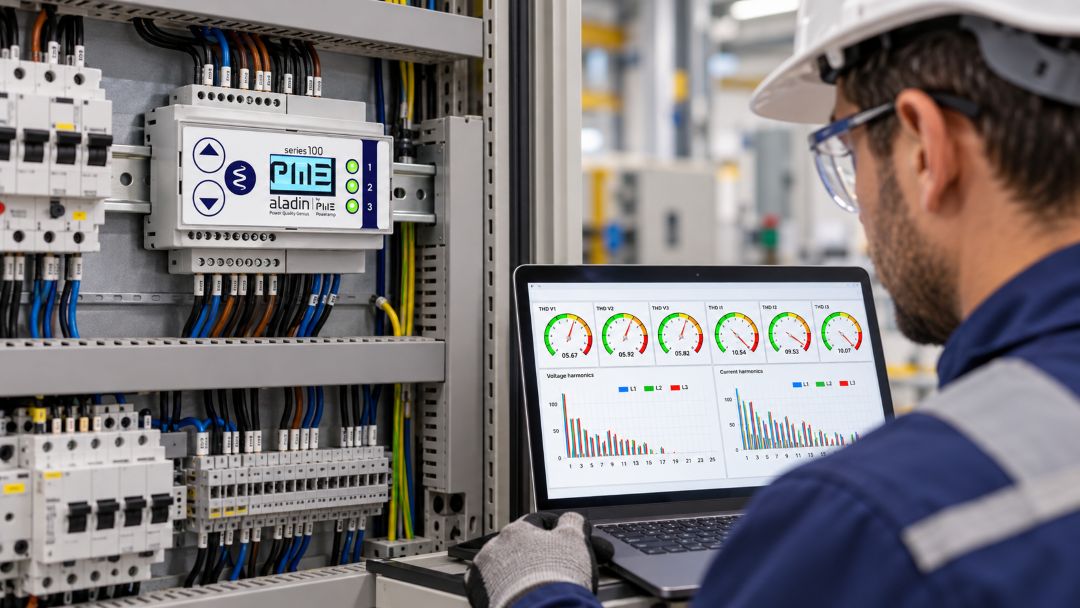
Aladin, Energia Europa’s diagnostic system, measures current and voltage harmonics up to the 50th order. It also monitors power factor, three-phase imbalance and voltage anomalies. The device can be installed at the main distribution point or close to specific loads, while Aladin View provides access to measurements and periodic reports.
Aladin is a diagnostic tool: it measures electrical disturbances; it does not filter harmonics. The data it collects help identify where corrective action is needed and which technology is appropriate, rather than relying on assumptions about energy use or equipment failures.
Would you like to assess your plant’s harmonic profile? Call +39 0445 510 156 or request information through our contact form.
Further reading: find out how the Aladin Power Quality Analyzer works in our interview with Daniele Chiumento.
How to eliminate or reduce harmonic currents
Eliminating every harmonic component is not always realistic or necessary. The aim is to reduce distortion to levels that are compatible with the electrical system and applicable technical requirements, after identifying the sources and evaluating the available options.
One approach is to address the loads themselves, for example by choosing drives with lower harmonic emissions or installing suitable line reactors and filters. In plants with loads that change throughout the working day, active compensation systems may be appropriate. These detect harmonic currents and inject compensating currents to reduce the harmonic contribution seen by the upstream supply.
Filter selection depends on the harmonic orders present, the current requiring compensation, the installation point and any other Power Quality problems identified. Location matters too: treating a group of non-linear loads near its point of connection is not necessarily equivalent to installing a device at the main distribution point.
Energia Europa’s PQ-LINE range addresses these requirements with devices that combine harmonic filtering, reactive power compensation and current balancing in different ways.
PQ-PRO and PQ-MAX: solutions for different requirements
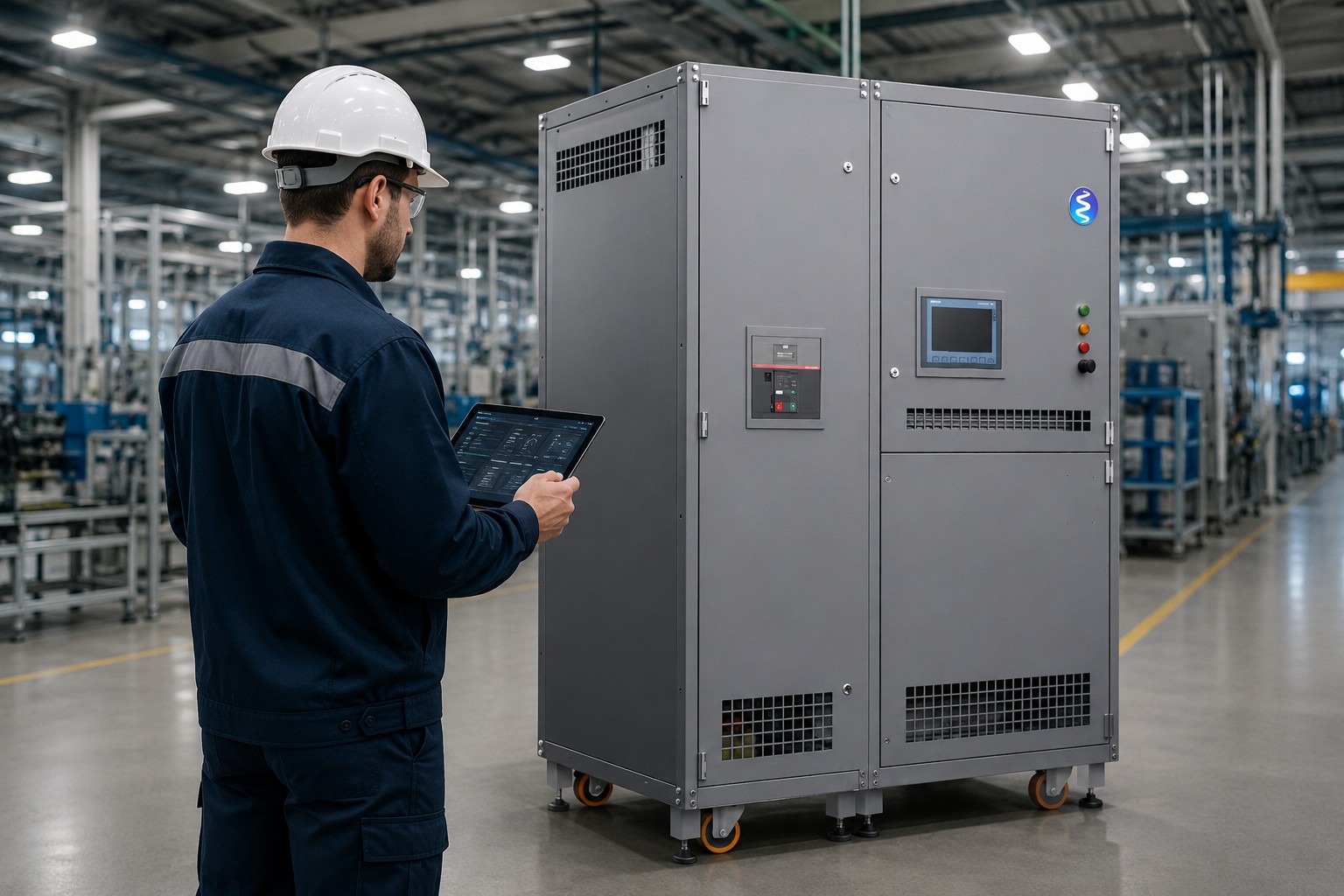
PQ-PRO uses ASVG (Advanced Static Var Generator) technology to compensate both even and odd current harmonics up to the 13th order. It also provides dynamic reactive power compensation and phase balancing. In its standard commercial configuration, priority is given first to power factor correction, then to current balancing and finally to harmonic mitigation. PQ-PRO is therefore worth considering when these issues coexist in the same installation.
PQ-MAX extends harmonic mitigation up to the 50th order, giving priority to filtering, followed by reactive power compensation and current balancing. Energia Europa recommends it particularly for environments that are sensitive to distortion, including data centers, robotics and advanced industrial automation.
The difference is not limited to the highest harmonic order each device can address. If the required compensation exceeds the available capacity, or other functions use part of that capacity, performance may vary. Selecting the appropriate model requires measurements and correct sizing, not just a comparison of product specifications.
KEY POINT — PQ-PRO compensates harmonics up to the 13th order and prioritizes power factor correction. PQ-MAX reaches the 50th order and prioritizes harmonic filtering. Correct sizing depends on actual measurements.
Need to select the right solution for your electrical loads? Contact Energia Europa on +39 0445 510 156 or use the contact form.
Further reading: learn how to choose between PQ-LINE Power Quality devices, with a technical comparison of PQ-VAR, PQ-PRO and PQ-MAX.
A real-world application: a data center in Finland
At a data center associated with Vatajankoski and E-Heat in Finland, measurements revealed high current harmonic distortion, capacitive reactive energy and excessive temperatures in the electrical room. Following a measurement campaign, Energia Europa’s partner OtsoSmart OY installed an OTSOMAX-RACK-600A device manufactured by Energia Europa.
According to the documented case study, after installation THDi fell to approximately 2% and the power factor reached 0.995, with the measured capacitive reactive power eliminated. These are results from that specific installation and should not be interpreted as guaranteed values for other plants.
The most useful lesson is the process followed: identify the anomalies, choose the appropriate device and verify the result. The same approach helps factories with variable-speed drives and changing loads address the underlying cause rather than just the symptoms.
Further reading: discover the Finnish data center case study in our article about The Smarter E Europe.
Frequently asked questions
How can harmonic currents be eliminated?
Harmonic currents can be reduced by addressing non-linear loads or installing appropriately sized harmonic filters. Energia Europa’s PQ-PRO and PQ-MAX devices provide active current harmonic compensation. Complete elimination is not always necessary or achievable.
What are the signs of harmonics in an electrical system?
Possible signs include overheating, unexpected protective-device trips and interference with electronic equipment. None of these signs confirms the diagnosis on its own: harmonic measurements and checks for other potential causes are required.
Do harmonics increase electricity costs?
Harmonic currents can increase losses in electrical components and affect system efficiency, but their financial impact varies from site to site. A given reduction in THDi cannot automatically be translated into a fixed percentage of energy savings.
What is the difference between PQ-PRO and PQ-MAX?
PQ-PRO compensates harmonics up to the 13th order and prioritizes power factor correction. PQ-MAX reaches the 50th order and prioritizes harmonic mitigation. Selecting the right device still requires an assessment of current levels and installation requirements.
Analyze your plant’s harmonics with Energia Europa
If you are noticing recurring electrical problems or expanding a production line with numerous electronic loads, a Power Quality assessment can help establish the priorities. Energia Europa offers a process that begins with diagnostics using Aladin and, when appropriate, progresses to an evaluation of PQ-PRO or PQ-MAX.
Call +39 0445 510 156 or complete the contact form to tell us about your electrical installation.